Article
How Smart Planner Classifies Eco-Friendly Transport Operators
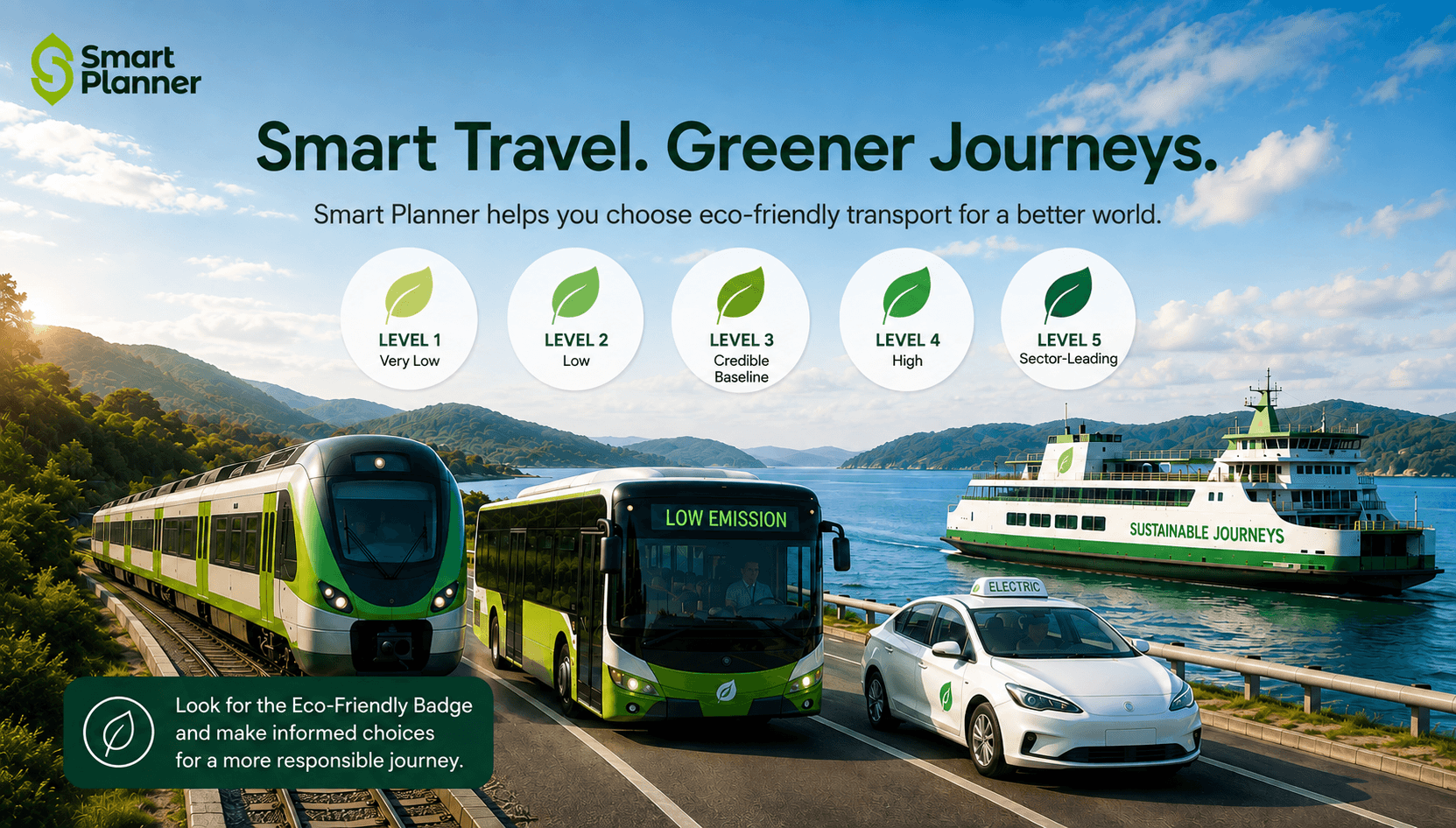
When planning a trip, the way we move between places can have a significant environmental impact. From trains and buses to ferries, coaches, shuttles and taxis, transport choices form an important part of the overall footprint of a journey.
At Smart Planner, we want to make it easier for travellers to understand these choices and make more informed decisions.
What is Smart Planner?
Smart Planner is an AI-powered regenerative tourism platform designed to help travellers and travel agencies plan and experience personalised, more meaningful journeys while connecting visitors with local culture, communities and responsible tourism experiences.
Across the Smart Planner platform, travellers can discover and compare accommodation, places to eat, activities, transport services, community initiatives and other tourism experiences relevant to their journey.
An important part of this experience is helping travellers understand the environmental practices associated with the services they are considering.
To make this information easier to recognise and compare, Smart Planner applies an Eco-Friendly Classification and Badge to eligible items listed across the platform, including passenger transport operators.
The classification provides a simple indication of the level of observable environmental practices associated with an operator, helping travellers incorporate environmental considerations alongside factors such as location, convenience, experience and personal preferences.
Developing a Framework Specifically for Transport
Transport requires a different approach to environmental assessment than accommodation, restaurants or tourism activities.
For this reason, Smart Planner requested the development of a dedicated Guest-Observable Eco-Friendliness Classification Framework for Passenger Transport Operators.
The framework is designed for passenger transport services including:
Rail operators
Ferries and passenger boats
Buses
Coaches
Shuttle services
Taxis
Rideshare services
Rental car operators
Similar ground and water passenger transport operators
Airlines are currently outside the scope of this framework.
Importantly, the framework evaluates the transport operator and its passenger service, rather than airports, railway stations, terminals, ports, public infrastructure owners or destination authorities.
The framework recognises that transport is an environmentally significant part of tourism. It therefore considers factors including fleet technology and energy sources, operational efficiency, pollution, waste, passenger behaviour and the quality of environmental information made available by operators.
A Guest-Observable Approach
Smart Planner's approach is deliberately based on information that a normal passenger can reasonably observe or verify.
This distinction is important.
The Eco-Friendly Classification is not intended to replace a comprehensive sustainability audit, lifecycle assessment, environmental certification or regulatory compliance review. Instead, it provides travellers with a practical classification based on information that can reasonably be identified through sources such as an operator's website, booking process, app, vehicles or vessels, published reports, recognised certification directories, recent passenger observations and information provided by staff.
For example, passengers may be able to determine whether a bus is electric, whether a taxi booking platform identifies electric vehicles, whether a ferry operator publishes information about its environmental programme, or whether a transport provider gives passengers practical guidance for choosing lower-impact travel options.
By contrast, travellers generally cannot independently verify complex information such as complete lifecycle emissions, exact fleet utilisation, electricity-grid carbon intensity, battery supply chains or detailed wastewater treatment performance. The framework therefore requires stronger documented or independently verified evidence before these types of claims can contribute significantly to a classification.
The Six Core Classification Criteria Used by Smart Planner
The complete transport framework considers a wider range of environmental factors. However, for the first version of the Smart Planner platform, the Eco-Friendly Classification focuses on six core classification criteria.
These core criteria have been selected because they represent some of the most important and reasonably verifiable environmental characteristics of passenger transport.
1. Verification, Truthful Claims and Public Data
The first criterion considers how clearly and credibly an operator communicates its environmental performance.
Simply describing a service as "green", "eco-friendly" or "sustainable" is not enough.
Smart Planner looks for operator-specific information such as fleet details, environmental policies, sustainability information, public performance indicators, transition plans, recognised certifications and independently verified evidence.
The stronger and more transparent the evidence, the stronger the potential classification.
This criterion is particularly important because the framework is designed to reduce the risk of unsupported environmental marketing or greenwashing. Environmental claims should be clear, specific and supported by appropriate evidence.
2. Fleet Energy, Greenhouse Gas Emissions and Transition Pathway
The type of vehicle or vessel used by an operator can significantly influence its environmental impact.
Smart Planner therefore considers observable and documented information about an operator's fleet, including whether it predominantly uses conventional fossil fuels or has introduced electric, hybrid, hydrogen or other lower-emission technologies.
The assessment can also consider whether the operator has published evidence of a meaningful fleet transition strategy, emissions targets or information demonstrating progress towards lower-emission operations.
A small number of lower-emission vehicles combined with broad environmental marketing will not necessarily result in a high classification. Higher classifications require stronger evidence that environmental improvements are material to the operator's actual fleet and operations.
3. Operational Efficiency, Occupancy and Routing
Eco-friendly transport is not determined by vehicle technology alone.
How efficiently a transport service operates also matters.
This criterion considers practices such as shared or capacity-based transport, route consolidation, occupancy management, reduced unnecessary empty running, anti-idling practices, eco-driving, energy monitoring and route optimisation.
For example, a well-utilised shared shuttle or coach can offer a very different environmental outcome from a poorly utilised service operating unnecessary journeys.
Higher classifications therefore recognise operators that can demonstrate systematic efforts to improve utilisation, routing and energy efficiency.
4. Passenger Guidance and Low-Impact Behaviour
Transport operators can also influence the environmental impact of a journey by helping passengers make better choices.
Smart Planner considers whether operators provide useful guidance rather than simply selling a ticket.
This might include information about public transport connections, shared travel options, luggage and bicycle policies, lower-impact service choices, or guidance incorporated directly into booking platforms, apps and onboard communications.
At more advanced levels, operators may provide passengers with service-specific carbon or environmental information supported by their own data.
The objective is to recognise operators that actively help passengers understand and choose more responsible ways of travelling.
5. Air and Noise Pollution, Together with Waste and Plastics
Environmental impacts are also visible at the local level.
Smart Planner considers issues such as vehicle exhaust, unnecessary idling, fumes, operational noise and the use of lower- or zero-tailpipe-emission vehicles.
Waste is also considered, particularly where it forms part of the passenger experience. This can include digital ticketing, recycling or waste bins, refill systems, onboard catering packaging and the reduction of avoidable single-use items.
Operators demonstrating widespread low-emission operations, meaningful noise reduction and systematic waste-reduction practices can therefore achieve stronger results under this criterion.
6. Mode-Specific Environmental Stewardship
The final core criterion recognises that environmental impacts differ depending on the type of transport being assessed.
For ferries and passenger boats, for example, the assessment can consider sewage, bilge, garbage management, wake, wildlife interactions, biofouling and other waterway-related environmental practices.
For land-based transport operators, the criterion is interpreted through relevant local environmental stewardship, such as unnecessary idling, route nuisance, visible depot practices and operations in pollution-sensitive areas.
This approach allows Smart Planner to maintain consistent environmental principles while recognising that a ferry, electric city bus, regional train and small shuttle service face very different operating conditions and environmental challenges.
How the Eco-Friendly Badge Works
The classification uses a 1-to-5 scale, where:
Badge | Classification | What it broadly means |
|---|---|---|
1 | Very Low | Environmental practices are largely absent, tokenistic, poorly demonstrated or potentially contradicted by observable practices. |
2 | Low | Some positive environmental actions are present, but they remain limited, weakly evidenced or primarily marketing-led. |
3 | Medium | The operator demonstrates a genuine and observable baseline of environmental practices across the core areas being assessed. |
4 | High | Environmental practices are systematic, cover multiple areas of the operation and are generally supported by meaningful evidence or performance data. |
5 | Very High | The operator demonstrates exceptional, consistent and transparent environmental performance, supported by strong public information and independent verification. |
The underlying framework intentionally makes the higher classifications more difficult to achieve. Level 5, in particular, is intended for operators demonstrating sector-leading performance rather than businesses simply making environmental claims.
Evidence Matters
A fundamental principle behind the Smart Planner classification is that environmental claims should be supported by evidence.
The framework recognises different strengths of evidence, ranging from independent certifications and audited reports through operator documentation and direct passenger observations to unsupported marketing claims.
Independent or externally verified evidence provides the strongest basis for higher classifications. Specific and current operator documentation can also provide strong evidence, while passenger observations are particularly useful for practices that can genuinely be seen during the travel experience.
Unsupported environmental marketing receives significantly less weight. Under the framework, claims such as "eco", "green", "carbon neutral" or "sustainable" without appropriate scope, dates, data or supporting evidence cannot, by themselves, justify a high score.
This evidence-based approach is intended to make the Smart Planner Eco-Friendly Badge useful to travellers while encouraging transparency across the tourism and transport industries.
Different Transport Modes Require Different Context
Smart Planner also recognises that transport operators cannot all be assessed in exactly the same way.
For rail operators, factors such as traction energy, electric versus diesel operation, renewable electricity, regenerative braking, energy efficiency, occupancy and emissions reporting may be particularly relevant.
For ferries and passenger boats, additional attention is given to issues such as sewage, garbage, bilge, air emissions, shore power, wake, wildlife disturbance and biofouling.
For buses, coaches and shuttles, the framework emphasises fleet fuel type, zero-emission transition, route consolidation, occupancy, anti-idling, eco-driving, charging infrastructure and passenger information.
For taxis and rideshare operators, considerations include vehicle type, electric and hybrid fleet participation, app transparency, shared rides, charging support, anti-idling and reducing unnecessary empty vehicle kilometres.
For rental car operators, Smart Planner considers factors such as the composition of the rental fleet, the availability of electric, hybrid and other lower-emission vehicles, how clearly these options are identified during the booking process, and whether customers are encouraged to select lower-impact vehicles where practical. The assessment can also consider evidence of fleet transition plans, charging support for electric vehicles, fuel and energy efficiency information, anti-idling or responsible-driving guidance, vehicle maintenance practices, waste reduction and credible environmental reporting. Operators that provide travellers with transparent information about vehicle type, energy source and environmental performance - rather than relying on broad “green” claims - can demonstrate stronger performance under the Smart Planner Eco-Friendly Classification. As with other land-based transport services, the assessment takes into account what is realistically achievable for the operator’s fleet, location and operating context.
This contextual approach is particularly important for smaller operators.
Smart Planner does not expect a small local shuttle business to have the same reporting resources as a national rail company. Strong, service-specific evidence and genuine environmental practices can still demonstrate credible performance. However, the highest classification continues to require strong independent evidence.
What the Eco-Friendly Classification Does - and Does Not - Mean
The Smart Planner Eco-Friendly Classification should be understood as a practical tool for travellers rather than a formal environmental certification.
It does not replace recognised environmental certifications, regulatory requirements, emissions inventories, lifecycle assessments or professional environmental audits.
There will also be environmental characteristics that Smart Planner cannot independently verify unless operators make credible information publicly available.
This is intentional.
The objective is to provide travellers with a transparent and understandable indication of what can reasonably be observed and verified, while avoiding giving excessive credit for broad environmental claims that cannot be substantiated.
Helping Travellers Make More Informed Choices
Smart Planner believes better information can help create better travel decisions.
The Eco-Friendly Badge is therefore not intended to tell travellers which transport operator they must choose. Instead, it provides another useful piece of information that travellers and travel professionals can consider alongside price, availability, accessibility, convenience, travel time and experience.
By making environmental information easier to understand, Smart Planner aims to help travellers identify operators taking meaningful action while encouraging tourism businesses and transport providers to communicate their environmental practices more clearly and transparently.
Are You a Transport Operator? Talk to us
Smart Planner understands that transport operations evolve.
Fleets change. Electric vehicles are introduced. New environmental programmes are implemented. Certifications are achieved. Waste is reduced. Operational practices improve. New sustainability reports and environmental performance data become available.
For this reason, an Eco-Friendly Classification does not need to be considered permanent.
If you are a transport operator listed on Smart Planner and believe your Eco-Friendly Classification does not accurately reflect your current practices, you can contact the Smart Planner team and request a review.
Providing current, operator-specific evidence - such as fleet information, environmental policies, sustainability reports, certifications, transition plans or other relevant documentation - can help the Smart Planner team reassess the classification using the applicable framework.
Through transparent classifications, better information and continued engagement with tourism operators, Smart Planner aims to make it easier for travellers to understand the environmental dimension of their journeys - and to recognise transport providers taking credible steps towards more responsible tourism.