Article
Beyond Sustainable Travel: Why Knowledge Alone Won’t Change Tourism

Griffith University in Australia has developed a strong research presence in tourism through the Griffith Institute for Tourism (GIFT), where researchers examine some of the major challenges and opportunities facing tourism destinations, businesses and travellers. Among its research areas are sustainable tourism, climate change, destination management and the transformation of tourism systems.
An important contribution to this discussion comes from Griffith researchers Professor Susanne Becken and Professor Alexandra Coghlan, authors of the academic paper Knowledge alone won’t “fix it”: building regenerative literacy, published in the Journal of Sustainable Tourism. Their paper challenges a simple but widespread assumption: that if people know more about climate change and sustainability, they will naturally make better decisions.
For tourism, this is an important question.
Travellers today have access to more information than ever before. We can learn about carbon emissions, responsible travel, wildlife conservation, local cultures and sustainable accommodation within seconds. Tourism businesses also have access to sustainability frameworks, carbon calculators, certification programmes, environmental guidelines and extensive research.
Yet having this information does not necessarily mean that travellers change how they travel or that businesses fundamentally change how they operate.
Becken and Coghlan argue that we need to move beyond simply providing more knowledge. What we need to develop is literacy: the ability to combine knowledge with values, attitudes, skills and actions.
And ultimately, they argue that tourism should aspire towards something even deeper: Regenerative Literacy.
We know more than ever, but is that changing how we travel?
Climate change is perhaps the clearest example of the gap between knowledge and action.
Awareness of climate change has increased enormously. Scientific knowledge has expanded, governments have established climate targets, businesses have developed sustainability strategies and consumers are increasingly exposed to environmental information.
However, knowledge has not translated into action at the scale required.
Becken and Coghlan point to a significant gap between the rapidly expanding scientific understanding of climate change and society's progress in addressing it. Within tourism specifically, decades of sustainable-tourism and climate research have produced an extensive body of knowledge, while tourism emissions have continued to rise.
This raises an uncomfortable question.
If knowledge alone were sufficient to change behaviour, shouldn't we already be seeing much greater change?
Think about this from the perspective of a traveller.
You might know that using public transport can have a lower environmental impact than hiring a car. You may understand that locally owned businesses can help keep more tourism spending within a destination. You may know that certain natural environments are vulnerable to visitor pressure.
But knowing these things does not necessarily mean they influence what you actually do.
When you arrive at a destination, convenience, price, habits, time, recommendations, reviews and availability all compete for your attention.
There is a considerable distance between knowing something and acting upon what you know.
From knowledge to literacy
This is where the concept of literacy becomes particularly useful.
Literacy traditionally referred to the ability to read and write, but the concept has expanded considerably. Becken and Coghlan explain that literacy can encompass combinations of competencies involving knowledge, attitudes and behaviour.
One way of understanding this is through three simple ideas:
Head - what we know.
Heart - what we value and care about.
Hand - what we actually do.
Knowing that an ecosystem is under pressure represents the head.
Developing a connection with that ecosystem and genuinely caring about its future engages the heart.
Choosing behaviour that protects or contributes positively to that ecosystem represents the hand.
The important point is that these elements interact.
Learning can change our attitudes. Experiences can deepen our understanding. Acting differently can make us curious to learn more. Connecting emotionally with a place can change our future behaviour.
Becken and Coghlan represent this process as a spiral of continuing learning and evolution, rather than a straight line from information to behaviour.
For travellers and tourism businesses, this presents a very different way of thinking about sustainable tourism.
It isn't simply about providing more sustainability information.
It is about helping people understand, connect and act.
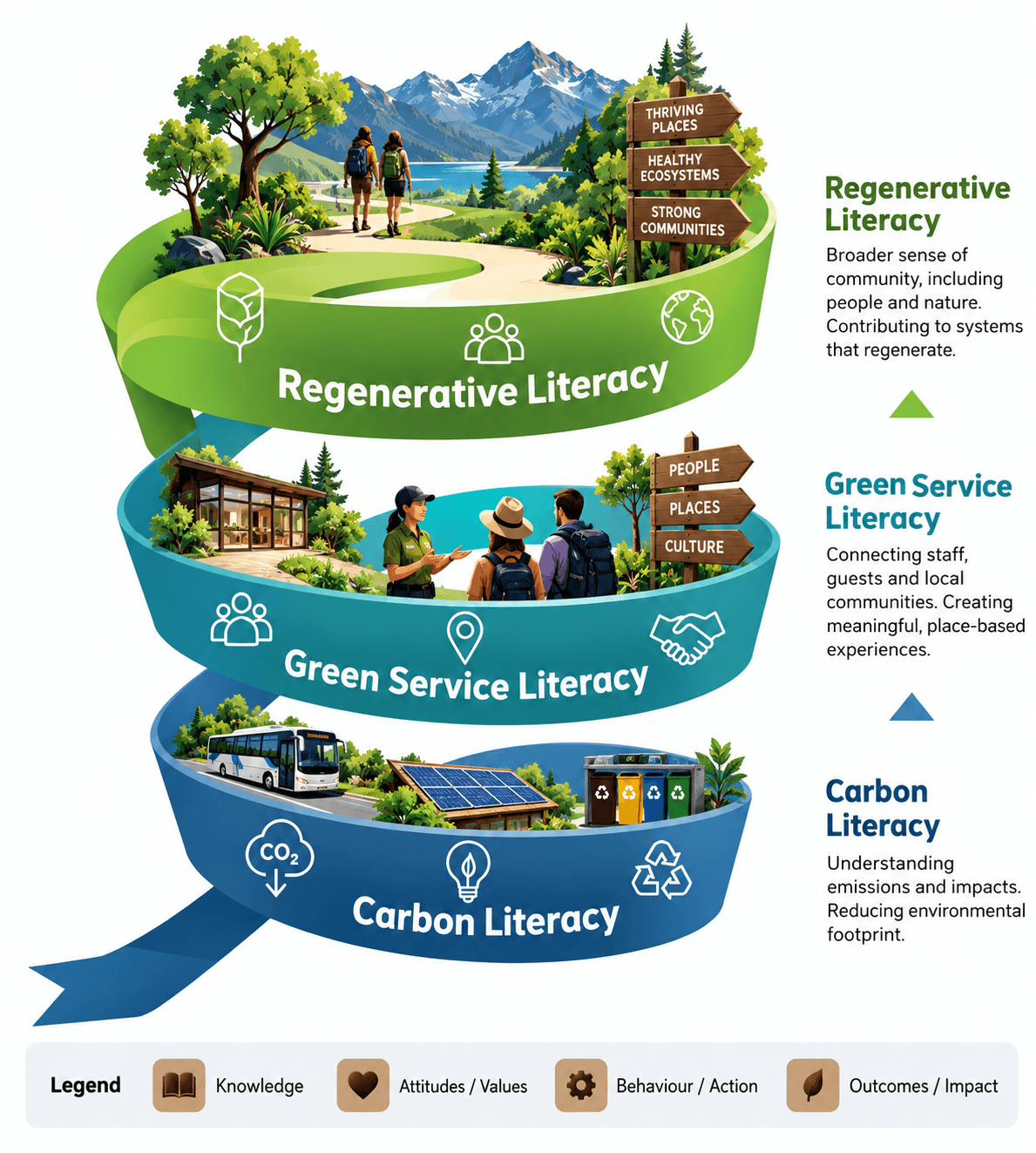
Carbon Literacy: understanding our impact
The first level described by Becken and Coghlan is Carbon Literacy.
Carbon Literacy involves understanding carbon emissions and developing the knowledge, attitudes and behaviours required to reduce them.
For a tourism business, this might involve understanding energy consumption, measuring emissions, reducing waste or identifying opportunities to operate more efficiently.
For travellers, it might mean understanding that different choices regarding transportation, accommodation, food and activities can have different environmental consequences.
There are already many initiatives within tourism focused on this level. Industry organisations provide net-zero roadmaps, emissions-measurement frameworks, sustainability guidelines and practical tools to help tourism businesses reduce their footprints.
These initiatives are important.
But there is a limitation.
A hotel manager can know precisely how much energy the property consumes without making significant changes. A traveller can understand the environmental benefits of public transport and still choose a private vehicle.
As Becken and Coghlan discuss, research does not show a simple relationship where increased carbon knowledge automatically produces lower consumption. Other factors, including attitudes, motivation, education and social relationships, can influence whether knowledge becomes action.
Carbon Literacy is therefore an important starting point, but it is not the destination.
Green Service Literacy: bringing people into the picture
Tourism is different from many industries because it is fundamentally about people, places and experiences.
A hotel room isn't simply a physical product. A guided walk isn't merely a transaction. A restaurant doesn't just deliver food.
Tourism brings visitors into contact with hosts, employees, communities, cultures and places.
Becken and Coghlan therefore propose extending Carbon Literacy into what they call Green Service Literacy.
Their framework introduces three particularly important groups:
staff, guests and local communities.
This makes sustainability much more human.
Imagine arriving at an accommodation property where the staff understand not only how the property's environmental systems operate, but also how to communicate those practices to you in a positive and engaging way.
Instead of simply finding a sign telling you to reuse your towels, you might learn about local water conditions, discover what the property is doing to reduce consumption and be shown simple ways to participate.
The interaction becomes part of the experience.
This requires tourism businesses to develop capabilities beyond technical sustainability knowledge. Staff need communication skills, cultural awareness, empathy and an understanding of the destination in which they operate.
The authors describe service as an opportunity for hosts and guests to create value together and develop outcomes such as respect, trust and empowerment.
That is a very different model from telling tourists what they should or should not do.
The visitor becomes a participant.
Helping travellers develop a relationship with place
One of the most powerful ideas emerging from Green Service Literacy is the importance of the local context.
A destination isn't simply a collection of hotels, attractions and restaurants.
It has history, ecosystems, people, traditions, challenges, stories and aspirations.
Tourism providers who understand this context can help travellers experience a destination differently. They can provide advice about appropriate behaviour, explain local customs, introduce visitors to local stories and connect them with experiences reflecting the character of the place.
Becken and Coghlan argue that Green Service Literacy creates opportunities for reciprocal learning between hosts, guests and communities.
This is particularly relevant as travellers increasingly search for authentic experiences.
Authenticity doesn't simply come from finding an attraction that hasn't appeared on social media yet. It can come from understanding why a place matters.
Who lives here?
What happened here?
What ecosystems support this place?
What challenges does the community face?
What do local people value?
What can visitors learn?
And perhaps most importantly:
How can visitors participate positively in the place while they are there?
These questions begin to move tourism beyond sustainability towards regeneration.
From sustainable tourism to regenerative tourism
Sustainability often asks:
How can we reduce our negative impact?
Regenerative thinking asks a different question:
How can our presence contribute positively to the place?
That distinction is fundamental.
Becken and Coghlan argue that even Green Service Literacy does not go far enough. Their third level, Regenerative Literacy, expands the idea of community beyond human communities to encompass the broader community of life.
The concept is influenced by deep ecology and principles articulated through the Earth Charter.
Instead of viewing humans and nature as separate systems, regenerative thinking considers us participants within interconnected ecological and social systems.
For tourism, this could fundamentally change how we define a successful visitor experience.
A sustainable tourism business might work hard to reduce the environmental damage it creates.
A regenerative tourism business might additionally ask:
What can we restore?
What can we strengthen?
What local initiatives can we support?
How can visitors contribute?
How can tourism improve relationships between people and place?
The difference can appear subtle, but the implications are substantial.
Imagine travel where visitors contribute to the destination
Consider a traveller visiting a natural destination for four days.
The conventional tourism journey might involve staying in a hotel, visiting the most popular attractions, eating at highly rated restaurants and purchasing a few activities.
The traveller might have a fantastic holiday.
But regenerative thinking asks what relationship existed between that visitor and the destination.
What did the traveller learn?
Did they meet local people?
Did they understand the environmental challenges facing the destination?
Did their spending support local businesses?
Did they discover community organisations?
Did they contribute to anything?
Did visiting the destination change how they think?
And was the destination somehow better because they came?
This doesn't mean every holiday needs to become environmental volunteering.
Contribution can take many forms.
A traveller might choose a locally owned tourism operator, participate in a conservation activity, support a community project, purchase locally produced food, visit a less congested part of a destination or simply learn enough about a place to behave more respectfully while visiting it.
Small actions can become part of a much broader relationship between visitor, host, community and environment.
Tourism experiences can become opportunities for transformation
Becken and Coghlan's argument goes deeper than changing individual travel decisions.
Regenerative Literacy involves reconsidering how we see ourselves in relation to other people and the natural world.
The authors draw upon transformative learning and describe a progression from "doing things better" to "doing better things", and eventually to recognising and questioning the worldview through which we understand the world.
Tourism has an unusual opportunity here.
Travel removes us temporarily from our normal routines.
We encounter unfamiliar environments, cultures, food, people and ways of living. That can make travel a powerful environment for learning.
A forest walk can simply be recreation.
But accompanied by a local guide who explains the ecology, history and restoration of that forest, it can become something more.
A meal can simply be dinner.
But discovering where the ingredients were produced, meeting local producers or learning about local food traditions can change the relationship between the traveller and what they consume.
The experience itself becomes a form of education.
This is why Becken and Coghlan associate regenerative tourism experiences with concepts such as place attachment, immersion in nature, kinship and reconnection with the history and culture of places.
A different role for tourism businesses
This framework also presents an opportunity for tourism operators.
Businesses don't have to see sustainability purely as a compliance exercise, certification requirement or operational cost.
They can become facilitators of better visitor experiences and better relationships with destinations.
An accommodation provider can connect guests with local initiatives.
A restaurant can tell the stories of its producers.
A tour operator can help visitors understand environmental restoration.
An attraction can educate visitors about local conservation challenges.
A guide can help travellers understand the cultural meaning of a place rather than simply showing them where to take photographs.
A business can provide visitors with opportunities to contribute to community projects.
In this model, sustainable and regenerative practices don't necessarily sit behind the scenes.
They can become part of the visitor experience itself.
The authors' framework therefore moves from carbon reduction towards service co-creation and eventually towards experiences that are deeply immersive and connected to place. Their examples of regenerative approaches include social enterprises, circular economies, cultures of care, storytelling and experiences that connect past, present and future.
Moving beyond telling travellers what to do
There is another important lesson here for destinations and tourism technology.
If knowledge alone doesn't reliably change behaviour, simply publishing more sustainability content isn't enough.
Visitors already face enormous amounts of information.
The opportunity is to provide the right information at the right moment and connect it to meaningful choices.
Imagine a traveller deciding what to do tomorrow.
Instead of simply presenting the ten most popular attractions, a travel platform could help them discover an experience matching their interests that is locally operated, less crowded and connected with conservation or community initiatives.
The visitor hasn't simply been told:
"Travel more sustainably."
They've been given an attractive and practical way to do it.
That distinction matters.
The objective shouldn't be to lecture travellers or make them feel guilty about travelling. It should be to give them the knowledge, context, opportunities and capabilities to make informed choices.
Over time, those experiences can help develop literacy.
Learn → connect → choose → experience → contribute → reflect → learn again.
That is much closer to the continuous process described by Becken and Coghlan's literacy spiral than simply presenting sustainability information.
Rethinking what successful tourism looks like
Perhaps the most challenging element of the paper is that Regenerative Literacy eventually forces us to question some assumptions underlying tourism itself.
The authors argue that genuine regenerative thinking may require reconsidering ideas around continuous material growth, consumption, conventional definitions of progress, humanity's domination of nature and the belief that technology alone can solve environmental problems.
For destinations, this raises important questions.
Should success always mean more visitors?
Could success instead include visitors staying longer, spending locally, travelling outside peak periods, exploring different locations, supporting community projects and leaving destinations healthier?
For tourism businesses, could success include not only financial returns but also measurable contributions to community and environmental wellbeing?
And for travellers, could a great holiday be measured not only by what we saw and did, but also by what we learned, who we connected with and what we contributed?
These aren't easy questions.
But they point towards a different vision of tourism.
Technology can help - but technology isn't the answer by itself
Interestingly, a technology platform such as Smart Planner must also take seriously one of the paper's central warnings.
Technology alone won't "fix it" either.
A better recommendation algorithm, more visitor data or more sophisticated artificial intelligence does not automatically produce regenerative tourism.
Technology becomes valuable when it helps connect people, knowledge, places and opportunities for action.
The role of technology can therefore be to make responsible choices easier to discover at exactly the moment travellers are making decisions.
Instead of optimising only for what is most popular, platforms can help travellers discover what is relevant to them and beneficial to the destination.
Instead of simply showing attractions, technology can explain the stories behind places.
Instead of only connecting visitors with commercial activities, platforms can connect them with community and environmental projects.
Instead of sustainability information sitting on a separate webpage that few visitors read, it can become integrated naturally into the travel experience.
And instead of simply telling people to behave responsibly, digital platforms can give them practical opportunities to act.
Helping travellers move from knowledge to action
This is the direction we believe travel technology should take.
Travellers don't necessarily need another platform telling them that sustainability matters. Many already understand that.
What they need is help translating that intention into their actual travel experience.
What can I do today?
Where can I go?
What should I know about this place?
Which businesses are making a positive difference?
What local projects could I support?
How can I contribute while I'm here?
Is there another experience nearby that better matches my interests and values?
These are questions that digital technology can help answer in real time.
And this is where Smart Planner Tourism sees an opportunity to contribute.
The Smart Planner Travel App will help travellers learn about the destinations they visit rather than simply discover things to do. Travellers will be able to explore local stories and information, discover community and environmental projects they can contribute to while at the destination, find more sustainable and eco-friendly options, learn about regenerative tourism operators and community initiatives, and better understand the places they are experiencing.
Most importantly, Smart Planner will help turn information into practical opportunities. Through on-demand recommendations and information, travellers will be able to discover relevant experiences and alternatives based on their interests and the destination around them.
Because creating better tourism isn't simply about giving travellers more information.
As Becken and Coghlan remind us, knowledge alone won't "fix it."
The greater opportunity is to help people learn, connect, choose, experience and contribute - turning travel itself into an opportunity to build literacy and creating a stronger relationship between travellers, tourism businesses, communities and the places we all depend upon.
Original article: Knowledge alone won't "fix it": building regenerative literacy